Summary
The 301 experts who responded to the quantitative questions in this 2025 Imagining the Digital Future Center canvassing predicted the likely impact of the change that they expect on 12 essential traits and capabilities by 2035.
They were asked:
How is the coming Humanity-Plus-AI future likely to affect the following key aspects of humans’ capacity and behavior by 2035 as compared to when humans were not operating with advanced AI tools?
Most of these experts predicted that change is likely to be mostly negative in the following nine areas:
- social and emotional intelligence
- capacity and willingness to think deeply about complex concepts
- trust in widely shared values and norms
- confidence in their native abilities
- empathy and application of moral judgment
- mental well-being
- sense of agency
- sense of identity and purpose
- metacognition
About
12 key human capacities and behaviors
Pluralities said they expect that change for humans in by 2035 is likely to be mostly positive in these areas:
- curiosity and capacity to learn
- decision-making and problem-solving
- innovative thinking and creativity.
You can access separate pages with full analyses on each of the 12 categories by clicking on the headline hyperlinks below. The fuller sections displayed on separate pages pair the quantitative results for each category with revealing related comments from many of the experts. The experts’ comments found on those 12 pages are brief excerpts from their longer responses to this study’s overarching essay question about what it will be like to be human in 2035. (Note: The numbering of the charts at the start of each of the separate pages is for ease of use; it does not represent any particular “ranking.”)
Click on any of the 12 links below to read a selection of excerpts from experts’ essays that touch on the topic.
Humans’ capacity and willingness to think deeply about complex concepts
These experts expect that by 2035 there will be…
50% – More negative change than positive change
21% – More positive change than negative change
21% – Fairly equal positive and negative change
7% – Little to no change
Many studies have shown that humans’ attention spans and their interest in and capacity for reading deeply and analytically are diminishing in the digital age. This has been attributed at least in part to the public’s voracious consumption of readily available quick hits of information and entertainment – especially on social media platforms and in instant search results. Over the past two decades, people have increasingly prioritized instant gratification over investing time in engaging with complex information. Many experts in this study noted humans’ preferences for taking shortcuts to results and for being entertained. They are worried trends that are already evident in such human behaviors will be magnified greatly when AI tools advance and spread. They noted the ability to be informed enough to actively engage with complex concepts is crucial to the future of human society. Read deeper details on the likely future of this trait by clicking on the “Humans’ capacity and willingness to think deeply” headline above and viewing the experts’ predictions and opinions.
Humans’ social and emotional intelligence
These experts expect that by 2035 there will be…
50% – More negative change than positive change
14% – More positive change than negative change
19% – Fairly equal positive and negative change
14% – Little to no change
Few of the respondents to this canvassing offered unqualifiedly positive predictions about AIs’ impact on social and emotional intelligence. Many are concerned about AI-driven interactions replacing or dramatically altering human-to-human emotional bonds. They say people may become less adept at reading social cues, expressing emotions effectively and being willing to engage with others in what can sometimes be messy or complicated interpersonal relationships. Some even predict that many humans will prefer AIs as life partners. They wonder why a human would maintain a reciprocal relationship with another person, which might require constant work, when a perfectly attuned and unneedy “synthete” is available. Read deeper details on the likely future of this trait by clicking on the “Humans’ social and emotional intelligence” headline above and viewing the experts’ predictions and opinions.
Humans’ confidence in their own native abilities
These experts expect that by 2035 there will be…
48% – More negative change than positive change
16% – More positive change than negative change
22% – Fairly equal positive and negative change
7% – Little to no change
A notable share of these experts focused on the problems that might arise as humans deepen their dependence on AI systems and agents and begin to see them as more capable of making choices than they truly are. This could lead people to lose confidence in their own judgment, possibly resulting in a loss of faith in themselves and a diminished expectation of the value of human involvement in conflict resolution, the handling of complex situations and retention of lessons learned from past experiences, plus the diminishment of humans’ own capabilities for self-reliance. A few said humans will be able to gain knowledge and have uplifting experiences through AI systems that build their confidence in their native abilities and understanding of the world, just as humans gain such wisdom from other humans. Read deeper details on the likely future of this trait by clicking on the “Humans’ confidence in their own native abilities” headline above and viewing the experts’ predictions and opinions.
Humans’ trust in widely shared values and cultural norms
These experts expect that by 2035 there will be…
48% – More negative change than positive change
10% – More positive change than negative change
24% – Fairly equal positive and negative change
11% – Little to no change
Keying off insights about the current state of community and political life, a plurality of these experts believe polarized and fragmented societies are likely to be evermore riven as AI tools advance, diminishing trust in institutions and in social arrangements. A recurring theme among those who are concerned is that while its uses can and will enhance human engagement in many respects, most AI platforms will continue to prioritize the goals of those in power and further empower bad actors. Many who expressed worries briefly commented that their hope is that society will get its act together before it is too late to change. Read deeper details on the likely future of this trait by clicking on the “Humans’ trust in widely shared values and cultural norms” headline above and viewing the experts’ predictions and opinions.
These experts expect that by 2035 there will be…
45% – More negative change than positive change
14% – More positive change than negative change
28% – Fairly equal positive and negative change
8% – Little to no change
As they considered this question, more experts than not referred to their concerns that AI tools might affect the core qualities of mental well-being – things like true companionship and authentic relationships, feelings of control and mastery of life experiences, exposure to meaningful emotional encounters, the quest for an integrated life and the yearning for solitude and a simplified life. A small share of the experts noted that AI systems mitigate loneliness and might bring the balm of contact with a wider exposure to people and ideas that align with them. A number of the essays that touched on the category of social and emotional intelligence also mentioned well-being; the impact of AI in both of these categories is seen as generally dependent on how the tech is designed and operated by powerful platforms and on how individuals personally choose to use these tools. Read deeper details on the likely future of this trait by clicking on the “Humans’ mental well-being” headline above and viewing the experts’ predictions and opinions.
Humans’ empathy and application of moral judgment
These experts expect that by 2035 there will be…
45% – More negative change than positive change
12% – More positive change than negative change
25% – Fairly equal positive and negative change
12% – Little to no change
Machine intelligence is being trained to express human-like empathy and kindness in transactions, and it is already being used to make data-based judgments in court decisions, hiring, mortgage applications and more. Many of these experts expressed concerns about AI’s impact on human empathy and moral judgment. Some worry that if moral and ethical decision-making is outsourced to AI at the same time that human-to-human in-person connections are being diminished, people may lose the ability to engage in the hard work of dealing with moral dilemmas critically. That, in concert with other diminished human capabilities, could reduce people’s abilities for ethical reasoning and remove them from a sense of personal responsibility. Read deeper details on the likely future of this trait by clicking on the “Humans’ empathy and application of moral judgement” headline above and viewing the experts’ predictions and opinions.
Humans’ individual agency and the ability to act independently
These experts expect that by 2035 there will be…
44% – More negative change than positive change
29% – More positive change than negative change
16% – Fairly equal positive and negative change
8% – Little to no change
The views expressed here echo findings from the Imagining the Digital Future Center’s past reports on the “Future of Human Agency“ and “Artificial Intelligence and the Future of Humans.” A plurality of these experts believes AI tools create a paradox of control, convincing individuals that they are enhancing their lives while shaping their decisions to suit others’ needs behind the scenes. Most of these experts expect uses of AI will weaken humans’ cognitive and strategic abilities, leading to less self-initiated problem-solving and the diminishment of moral judgment. They also note that as AI systems are further embedded in key systems of business, law and government, they are likely to further remove humans from many critical decision processes altogether. Read deeper details on the likely future of this trait by clicking on the “Humans’ individual agency and the ability to act independently” headline above and viewing the experts’ predictions and opinions.
Humans’ self-identity, meaning and purpose in life
These experts expect that by 2035 there will be…
39% – More negative change than positive change
18% – More positive change than negative change
24% – Fairly equal positive and negative change
14% – Little to no change
More experts than not see negative outcomes as they imagine how the humans-plus-AI evolution affects people’s identities and their sense of meaning and purpose in their lives. Many said there are many potentially daunting challenges ahead as people try to maintain a coherent sense of self in a world where AI increasingly mediates and simultaneously expands the potential for human-to-human experiences and relationships and human-synth experiences and relationships. They worry about the fragmentation of identity through multiple digital personas and the potential loss of traditional sources of meaning and purpose, particularly those found through jobs/work. However, some experts see enhanced human flourishing. Read deeper details on the likely future of this trait by clicking on the “Humans’ self-identity, meaning and purpose in life” headline above and viewing the experts’ predictions and opinions.
Humans’ metacognition – the ability to think analytically about thinking
These experts expect that by 2035 there will be…
36% – More negative change than positive change
27% – More positive change than negative change
20% – Fairly equal positive and negative change
14% – Little to no change
The contention of those who are anxious about the fate of people’s ability to examine their own assumptions and thought processes goes like this: When AI constantly mediates decision-making, individuals may lose confidence in their own reasoning abilities, struggle with metacognitive monitoring of their own thought processes and default to AI recommendations without critically assessing them. The counter-case some experts make goes like this: AI could serve as a mirror to help people understand their own cognitive biases and thinking patterns. In addition, AI’s aggregation of collective intelligence could expand people’s perspectives, even “how we create understanding itself.” There were comments, as well, about the possibility that machines may become self-aware, even achieving an “artificial consciousness.” Read deeper details on the likely future of this trait by clicking on the “Humans’ metacognition” headline above and viewing the experts’ predictions and opinions.
Humans’ curiosity and capacity to learn
These experts expect that by 2035 there will be…
29% – More negative change than positive change
42% – More positive change than negative change
23% – Fairly equal positive and negative change
5% – Little to no change
The experts’ views were more likely to be positive than negative about the effect AI will have on curiosity and the capacity to learn. While very few of the people who wrote essay responses mentioned this category as growing in strength as a human trait by 2035, many expect that people’s implementation of AI and the knowledge gained through the use of AI tools will expand their personal capacity for learning and motivate them to be more curious than when they are operating under the power of their own human capabilities alone. Many of the essayists also expressed concerns that humans’ growing dependence on AI systems will narrow their cognitive experience to the point at which they simply outsource their essential selves to machine outputs. They fret about atrophy of humans’ capacity to learn as their innate curiosity dampens. ead deeper details on the likely future of this trait by clicking on the “Humans’ curiosity and capacity to learn” headline above and viewing the experts’ predictions and opinions.
Humans’ decision-making and problem-solving abilities
These experts expect that by 2035 there will be…
30% – More negative change than positive change
40% – More positive change than negative change
25% – Fairly equal positive and negative change
3% – Little to no change
The experts’ views were more likely to be positive than negative about the influence that humans’ further adoption of AI tools and systems will have on their decision-making and problem-solving skills. A number of them expect that the implementation of AI and the knowledge gained through the use of AI tools will somehow expand humans’ own individual capacities in decision-making and problem-solving. Some predicted that when AI systems tackle low-priority tasks, relieving people of some of their cognitive burden will allow them to shift their attention to more important issues and tasks. Some expect that the knowledge gained through the use of AI tools will allow people to be more insightful about how they make choices when they are operating under the power of their own human capabilities alone. Others worry, however, about the negative implications of humans deferring all of their critical thinking to machine intelligence. They fret about atrophy of humans’ capacity to learn as their innate curiosity dampens. Read deeper details on the likely future of this trait by clicking on the “Humans’ decision-making and problem-solving abilities” headline above and viewing the experts’ predictions and opinions.
Humans’ innovative thinking and creativity
These experts expect that by 2035 there will be…
30% – More negative change than positive change
39% – More positive change than negative change
25% – Fairly equal positive and negative change
3% – Little to no change
The optimistic experts expect that humans’ implementation of AI and the knowledge they gain through the use of AI tools will help expand their own, individual capabilities for creativity and innovation as they begin to think and create in new ways, exploring numerous possible sources of inspiration and discovering striking new possibilities for expression. Others worry about the loss of some essential human elements of creativity that AI cannot necessarily replicate – the struggle, vision and deep understanding that come from the laborious, hard work of mastering a craft. Another concern is an overall “standardization to the mean” or humanity settling for repetitive mediocrity. Read deeper details on the likely future of this trait by clicking on the “Humans’ innovative thinkikng and creativity” headline above and viewing the experts’ predictions and opinions.
Source: ITDF
Explaining the 12 human traits
Continue reading:
12 Key Capacities
Capacity and willingness to think deeply about complex concepts
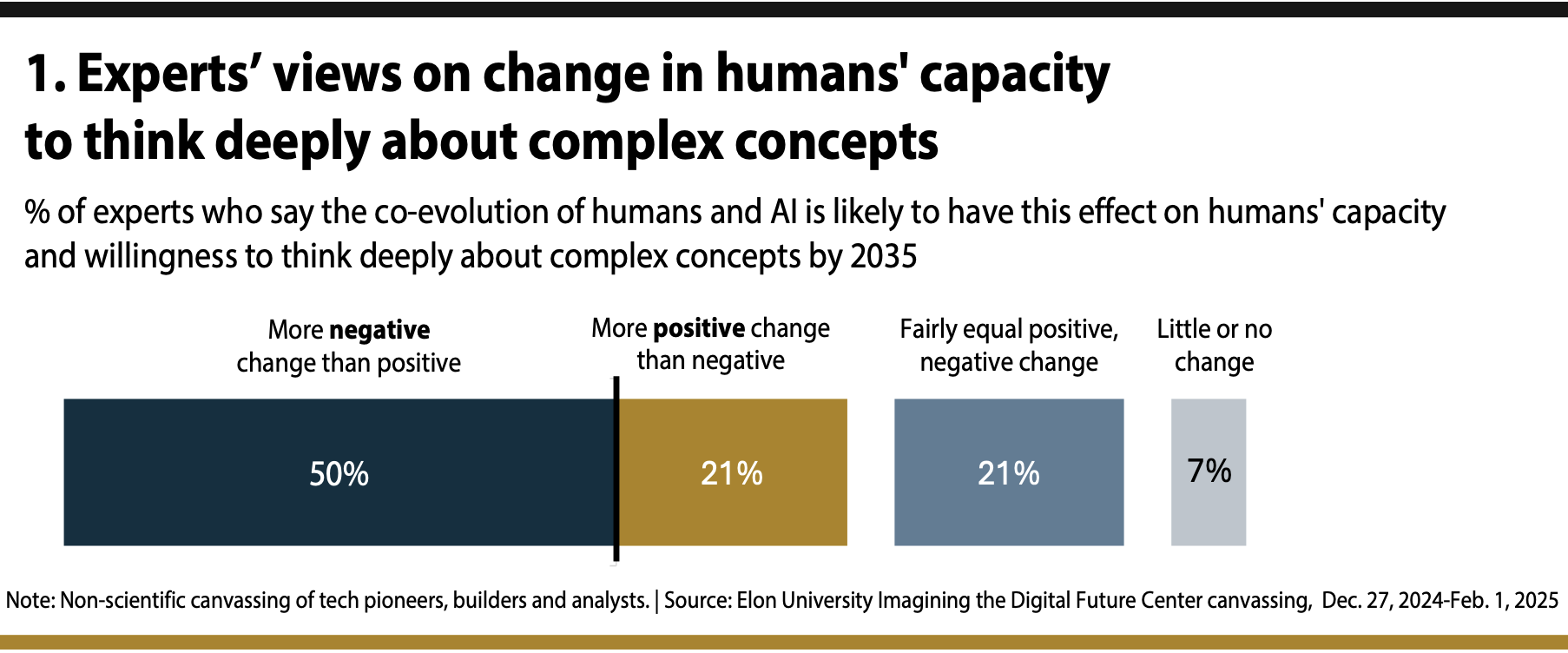
These experts expected in 2025 that by 2035 there will be…
50% – More negative change than positive change
21% – More positive change than negative change
21% – Fairly equal positive and negative change
7% – Little to no change
Many studies have shown that humans’ attention spans and their interest in and capacity for reading deeply and analytically are diminishing in the digital age. This has been attributed at least in part to the public’s voracious consumption of readily available quick hits of information and entertainment – especially on social media platforms and in instant search results. Over the past two decades, people have increasingly prioritized instant gratification over investing time in engaging with complex information. Many experts in this study noted that the ability to be informed enough to actively engage with complex concepts is crucial to the future of human society. Some argued that deep thinking builds phronēsis, the practical, context-sensitive capacity for self-correcting judgment and a resulting practical wisdom unobtainable without hard work. Some fear that by 2035 more people will not apply the focus and find the motivation needed to seek reliable sources in building their foundational knowledge, potentially widening polarization, broadening inequities and diminishing human agency.
A selection of related quotes extracted from these experts’ longer essays:
“By 2035, the impacts will probably be mostly negative when it comes to changes in human abilities. We know from research in psychology that cognitive effort is aversive for most people in most circumstances. The ability of AI systems to perform increasingly powerful reasoning tasks will make it easy for most humans to avoid having to think hard and thus allow that muscle to atrophy even further. I worry that the urge to think critically will continue to dwindle, particularly as it becomes increasingly harder to find critical sources in a world in which much internet content is AI-generated. … Knowledge/expertise is likely to be downgraded as a core human value. A positive vision is that humans will embrace values like empathy and human connection more strongly, but I worry that it will take a different turn in which core humanity focuses more on the human body, with physical feats and violence becoming the new core trait of the species.” – Russell Poldrack, psychologist, neuroscientist and director of the Stanford Center for Reproducible Neuroscience
“The capacity for deep thinking about complex concepts may face particular challenges as AI systems offer increasingly sophisticated outputs that could reduce incentives for independent analysis. This dynamic recalls patterns we’ve observed in our research on community engagement with AI systems, where convenience can inadvertently reduce participatory decision-making. … By 2035, the quality of human-AI interaction will largely depend on the governance frameworks we develop today. … Success will require moving beyond technical capabilities to consider how these systems integrate with and support human social structures.” – Marine Ragnet, affiliate researcher at the New York University Peace Research and Education Program
“The risks and threats of such deskilling have been prominent in ethics and philosophy of technology as well as political philosophy for several decades now. … Our increasing love of and immersion into cultures of entertainment and spectacle distracts us from the hard work of pursuing skills and abilities central to civic/civil discourse and fruitful political engagement. … Should we indeed find ourselves living as the equivalent of medieval serfs in a newly established techno-monarchy, deprived of democratic freedoms and rights and public education that is still oriented toward fostering human autonomy, phronetic judgment and the civic virtues then the next generation will be a generation of no-skilling as far as these and the other essential virtues are concerned.” – Charles Ess, professor emeritus of ethics at the University of Oslo
“While AI augments our capabilities, it may simultaneously weaken our independent competence in basic cognitive functions that historically required active engagement and repetition. … AI will turbocharge the pollution of our information ecosystem with sophisticated tools to create and disseminate misinformation and disinformation. This, in turn, will create deeper echo chambers and societal divisions and fragment shared cultural experiences. As AI becomes more pervasive, a new digital divide will emerge, creating societal hierarchies based on AI fluency. Individuals with greater access to and mastery of AI tools will occupy higher social strata. In contrast, those with limited access to or lower AI literacy will be marginalized, fundamentally reshaping social stratification in the digital age.” – Alexa Raad, longtime technology executive and host of the TechSequences podcast
“AI has the potential to improve the ‘cognitive scaffolding’ of human behavior just as computers, the internet and smartphones have done in the past. It will become easier to find and synthesize information, making our connection to the digital world even deeper than it already is in both professional and personal settings. … Depending on how we develop and apply AI systems, there is both an opportunity for AI to mostly empower human intelligence and creativity by scaffolding their intellectual pursuits, as well as a threat that AI will erode intelligence and creativity by forcing human behavior into following AI-amenable patterns.” – Bart Knijnenberg, professor of human-centered computing, Clemson University“
By 2035, the relationship between humans and AI will likely evolve from today’s tool-based interaction into a complex symbiotic partnership, fundamentally reshaping what it means to be human while preserving core aspects of human identity and agency. This transformation will manifest across three key dimensions: cognitive augmentation, social relationships and institutional structures. … AI will likely develop as a cognitive enhancement layer, creating ‘augmented intelligence’ that supports rather than replaces human judgment. Human feedback in the AI lifecycle is critical here as it ensures that AI systems align with human values and preferences. By iteratively incorporating feedback from diverse users, AI can be trained to enhance human decision-making while respecting individual agency and cultural contexts.” – Wayne Wei Wang, Ph.D. candidate in computational legal studies at the University of Hong Kong and CyberBRICS Fellow at FGV Rio Law School, Brazil

